

Sonder is an Audio Visual Interactive Installation inspired by the term
“the realisation that each random passerby is living a life as vivid and complex as your own”.
The piece invites visitors to step into that feeling, using layered audios, visuals and responsive design to create this immersive experience.






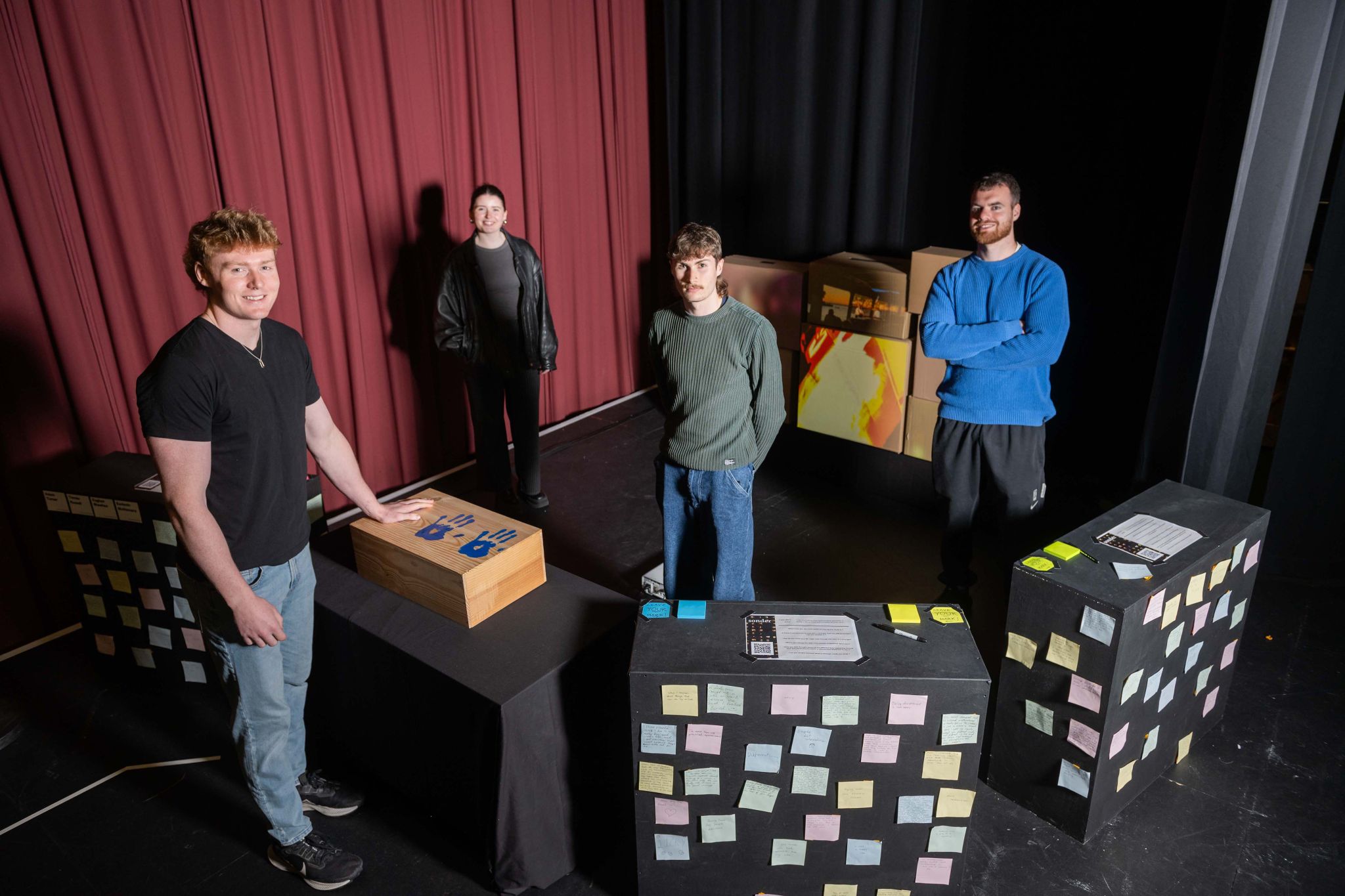
A final year project for the Bachelor of Arts in Creative Digital Media at MTU Cork:
Adam Turner,
Eadaoin McNamara,
Eoghan Sheehan
Tomás Russell.
A final year project for the Bachelor of Arts in Creative Digital Media at MTU Cork:
Adam Turner,
Eadaoin McNamara,
Eoghan Sheehan
Tomás Russell.
A final year project for the Bachelor of Arts in Creative Digital Media at MTU Cork:
Adam Turner, Eadaoin McNamara, Eoghan Sheehan & Tomás Russell.
Shortlisted for the 2025 IDI Graduate Design Awards in the category of Digital Design.
The installation uses projection mapping, real-time soundscapes, and tangible computing to create a sensory environment that responds dynamically to audience interaction. The core concept revolves around encouraging empathy through interactivity. Visitors influence the space using capacitive touch sensors. These technologies alter the audiovisual environment in subtle but meaningful ways shifting textures, evolving projections, and transforming soundscapes making each interaction unique.
This design approach ensures that every individual not only experiences the installation but contributes to its ongoing evolution. Key design decisions include using Arduino microcontrollers for tactile responsiveness and interaction, allowing for a layered experience. Projection mapping was chosen to create immersive storytelling environments without physical barriers. These decisions all support the overarching goal of fostering human connection through art and technology.
The project is designed for a wide and diverse public audience, including arts festival attendees, gallery visitors, and community participants of all ages. It especially appeals to those interested in immersive experiences, public art, and interactive storytelling. The installation is accessible to both casual participants and those with a deeper interest in media art, sound design, and digital interactivity.
The installation uses projection mapping, real-time soundscapes, and tangible computing to create a sensory environment that responds dynamically to audience interaction. The core concept revolves around encouraging empathy through interactivity. Visitors influence the space using capacitive touch sensors. These technologies alter the audiovisual environment in subtle but meaningful ways shifting textures, evolving projections, and transforming soundscapes making each interaction unique.
This design approach ensures that every individual not only experiences the installation but contributes to its ongoing evolution. Key design decisions include using Arduino microcontrollers for tactile responsiveness and interaction, allowing for a layered experience. Projection mapping was chosen to create immersive storytelling environments without physical barriers. These decisions all support the overarching goal of fostering human connection through art and technology.
The project is designed for a wide and diverse public audience, including arts festival attendees, gallery visitors, and community participants of all ages. It especially appeals to those interested in immersive experiences, public art, and interactive storytelling. The installation is accessible to both casual participants and those with a deeper interest in media art, sound design, and digital interactivity.
The installation uses projection mapping, real-time soundscapes, and tangible computing to create a sensory environment that responds dynamically to audience interaction. The core concept revolves around encouraging empathy through interactivity. Visitors influence the space using capacitive touch sensors. These technologies alter the audiovisual environment in subtle but meaningful ways shifting textures, evolving projections, and transforming soundscapes making each interaction unique.
This design approach ensures that every individual not only experiences the installation but contributes to its ongoing evolution. Key design decisions include using Arduino microcontrollers for tactile responsiveness and interaction, allowing for a layered experience. Projection mapping was chosen to create immersive storytelling environments without physical barriers. These decisions all support the overarching goal of fostering human connection through art and technology.
The project is designed for a wide and diverse public audience, including arts festival attendees, gallery visitors, and community participants of all ages. It especially appeals to those interested in immersive experiences, public art, and interactive storytelling. The installation is accessible to both casual participants and those with a deeper interest in media art, sound design, and digital interactivity.
For more info on each artist:
Adam Turner
Adam Turner
Portfolio: https://adamturner.mmm.page/
Portfolio: https://adamturner.mmm.page/
Instagram: https://www.instagram.com/adam.turner125
Instagram: https://www.instagram.com/adam.turner125
Eadaoin McNamara
Eadaoin McNamara
Eoghan Sheehan
Eoghan Sheehan
Portfolio: https://eoghansheehan.framer.website/
Portfolio: https://eoghansheehan.framer.website/
Instagram: https://www.instagram.com/eoghan_s_
Instagram: https://www.instagram.com/eoghan_s_
Tomás Russell
Tomás Russell
Instagram: https://www.instagram.com/tomasrussell
Instagram: https://www.instagram.com/tomasrussell